SIS EDI Excellence Award | Alice Parrinello: New Queer South. Perspectives on Italian Society and Culture
Alice Parrinello
Since Italian Unification, the depiction of Southern Italy has been shaped by a pervasive rhetoric of backwardness, contrasted with an image of productivity and industriousness attributed to the North. In addition to this economic framing, an anti-meridionalist discourse assigns various negative traits to the South, such as laziness and moral corruption, and operates through specific racialising and sexualising processes that construct Southerners as ‘others’.
Throughout the years, anti-meridionalism has been opposed in the works by several scholars, such as Franco Cassano, whose pensiero meridiano promoted ‘an epistemological motion through which the south begins to think about itself on its own, reconquering the ancient dignity of subject of thought’.[1] Cassano’s work fosters a decentralising move, one that will no longer uphold Western frameworks, but will understand Italy’s South through its connection to the Global South.[2] Similarly, Goffredo Polizzi argues that there is currently a transnational, a south-on-south, reimagining of Italy’s meridione beyond the stereotypes.[3] Furthermore, numerous scholars are now linking an epistemology of the South to a discussion of Southern Italian societal structures through queer and feminist theory and are seeing the North and South binary, rather than a divide, more as a dialectic.[4]
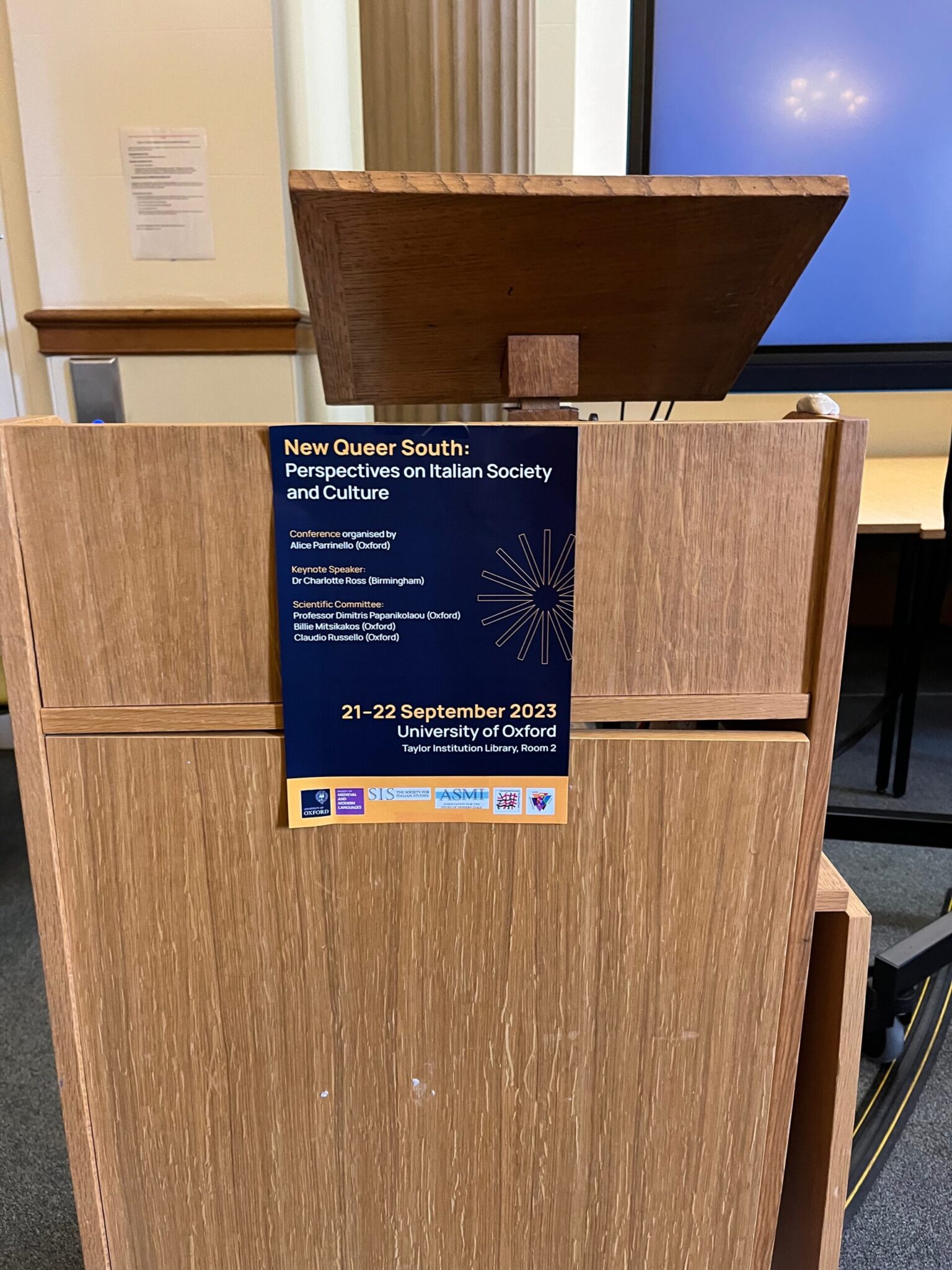
With the support of Dimitris Papanikolaou, Billie Mitsikakos, and Claudio Russello, in 2023 I organised a conference titled “New Queer South: Perspectives on Italian Society and Culture,” which took place at the University of Oxford on 21-22 September. Its aim was to explore the intersection of Southerness and queerness, in order to untangle the division between North and South and to investigate the double marginalisation of Southern LGBTQIA+ individuals, focusing on the cultural and activist strategies they develop to resist their discrimination.
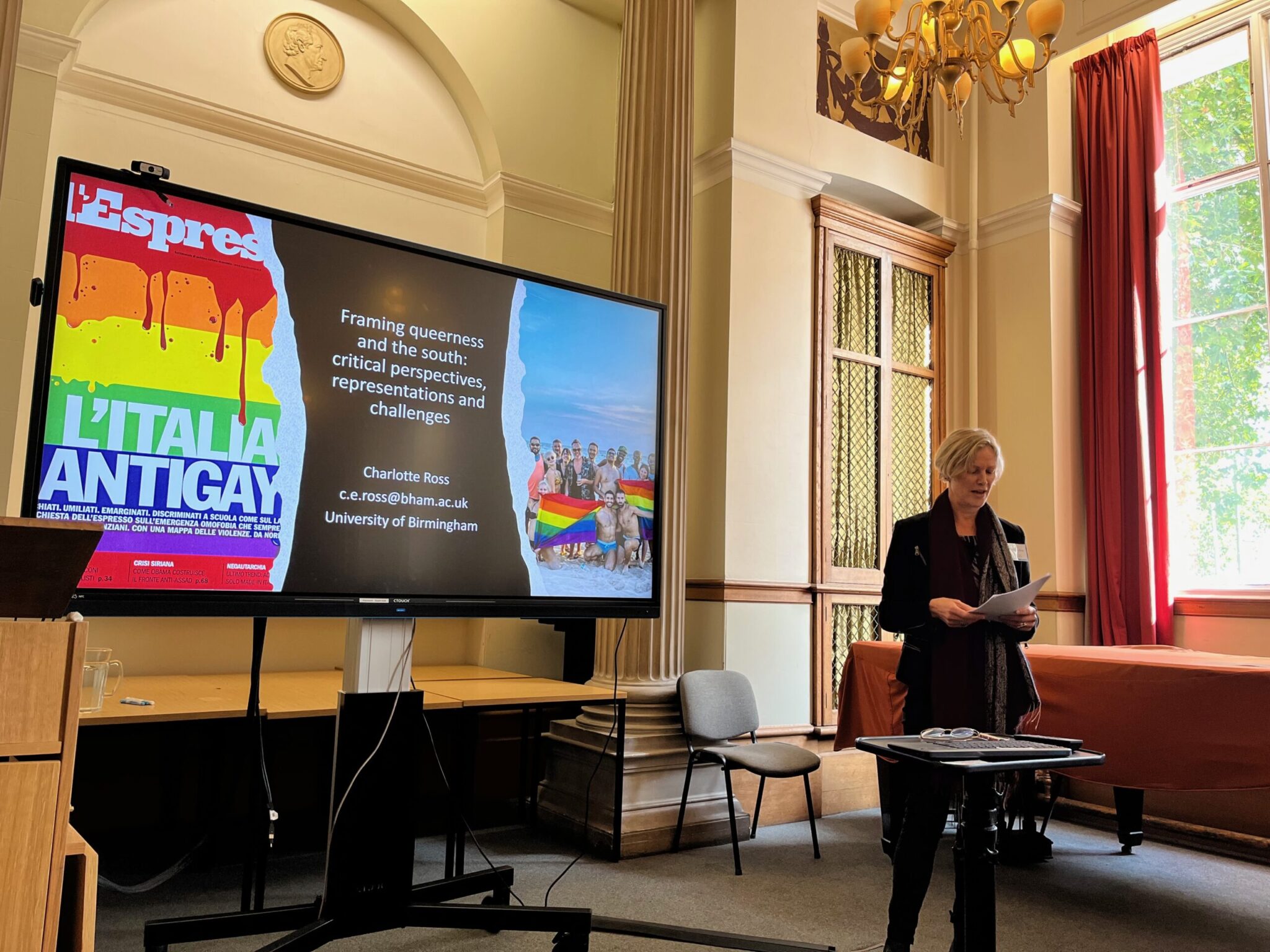
Charlotte Ross’ keynote speech opened the conference by problematising the three main keywords ‘new’, ‘queer’, and ‘South’ and laying out several themes, which were further explored during the event. Afterwards, the speakers presented their research during five panels, ‘Displacement’, ‘The Sociology of Queerness’, ‘Femminielli’, ‘Literary Mappings’, and ‘Centre/Periphery’. ‘Displacement’ focused on the disruption of essentialising gender roles in poetry and cinema (Francesca Romana Ammaturo, Stefano Rossoni, Marzia D’Amico), while ‘The Sociology of Queerness’ explored a transfeminist association group in Palermo, Rome activism, and the history of HIV/AIDS in Sicily (Valentina Amenta, Martina I. Millefiorini, Leonardo Campagna). ‘Femminelli’ investigated the history and representation of the Neapolitan femminelli (Luca Starita, Frances Clemente, Jules de Bellis, Marco Ruggieri), ‘Literary Mappings’ focused on the literary representations of the queer South (Carla Panico, Gian Pietro Leonardi), while the final panel, ‘Centre/Periphery’ examined queer eccentricities in cinema and theatre (Maria Elena Alampi, Stefania Lodi Rizzini, Dani Martiri).
Overall, the conference questioned key aspects of anti-meridionalist rhetoric while simultaneously creating space for Southern queerness within an academic context for the first time. The papers not only excavated a queer and Southern cultural past but also pointed toward a new understanding of both Italy’s meridione and queerness. Negotiating with the similarities and differences between Global South epistemologies and those of Southern Italy, the papers argued that the meridione possesses rich cultural and intellectual traditions, and that it is a space where queerness can emerge outside Anglo-American frameworks of legibility. Ultimately, Southern queerness resists anti-meridionalist rhetoric and can help dismantle long-held assumptions about Italy, its culture, and its socio-geography.
Undoubtedly, the conference will serve as a springboard for future events and research on the topic. For instance, the conference’s legacy is presently taking shape in a forthcoming special issue of gender/sexuality/italy. This publication will underscore the importance of integrating a queer and Southern perspective into Italian Studies and its potential for rethinking established narratives and methodologies in the field. Ultimately, the issue will consolidate the contribution of the “New Queer South” conference and underline the value of inclusive and intersectional approaches in Italian scholarship.
Bibliography
Acquistapace, Alessia, Elia A. G. Arfini, et al. 2016. ‘Tempo di essere incivili: Una riflessione terrona sull’omonazionalismo in Italia al tempo dell’austerity’, Il genere tra neoliberismo e neofondamentalismo, ed. by Federico Zappino (Ombre Corte), pp. 61-73.
Amenta, Valentina and Claudia Fauzia. 2024. Femminismo terrone: Per un’alleanza dei margini (Tlon).
Ammaturo, Francesca Romana. 2019. ‘“The More South You Go, the More Frankly You Can Speak”: Metronormativity, Critical Regionality and the LGBT Movement in Salento, South-Eastern Italy’, Current Sociology, 67.1, pp. 79–99.
Cassano, Franco. 2001. ‘Southern Thought’, Thesis Eleven, 67.1, pp. 1-10.
——. 2012. Southern Thought and Other Essays on the Mediterranean, edited by Norma Bouchard and Valerio Ferme (Fordham University Press).
Ferrante, Antonia Anna. 2019. Pelle queer maschere straight: Il regime di visibilità Omonormativo oltre la televisione (Mimesis Edizioni).
Polizzi, Goffredo. 2022. Reimagining the Italian South. Migration, Translation and Subjectivity in Contemporary Italian Literature and Cinema (Liverpool University Press).
[1] Franco Cassano, ‘Southern Thought’, Thesis Eleven, 67.1 (2001), pp. 1-10 (p. 2).
[2] Franco Cassano, Southern Thought and Other Essays on the Mediterranean, ed. by Norma Bouchard and Valerio Ferme (Fordham University Press, 2012).
[3] Goffredo Polizzi, Reimagining the Italian South. Migration, Translation and Subjectivity in Contemporary Italian Literature and Cinema (Liverpool University Press, 2022).
[4] Please see: Alessia Acquistapace, Elia A. G. Arfini, et al, ‘Tempo di essere incivili: Una riflessione terrona sull’omonazionalismo in Italia al tempo dell’austerity’, Il genere tra neoliberismo e neofondamentalismo, ed. by Federico Zappino (Ombre Corte, 2016), pp. 61-73; Valentina Amenta and Claudia Fauzia, Femminismo terrone: Per un’alleanza dei margini (Tlon, 2024); Francesca Romana Ammaturo, ‘“The More South You Go, the More Frankly You Can Speak”: Metronormativity, Critical Regionality and the LGBT Movement in Salento, South-Eastern Italy’, Current Sociology, 67.1 (2019), pp. 79–99; Antonia Anna Ferrante, Pelle queer maschere straight: Il regime di visibilità Omonormativo oltre la televisione (Mimesis Edizioni, 2019).