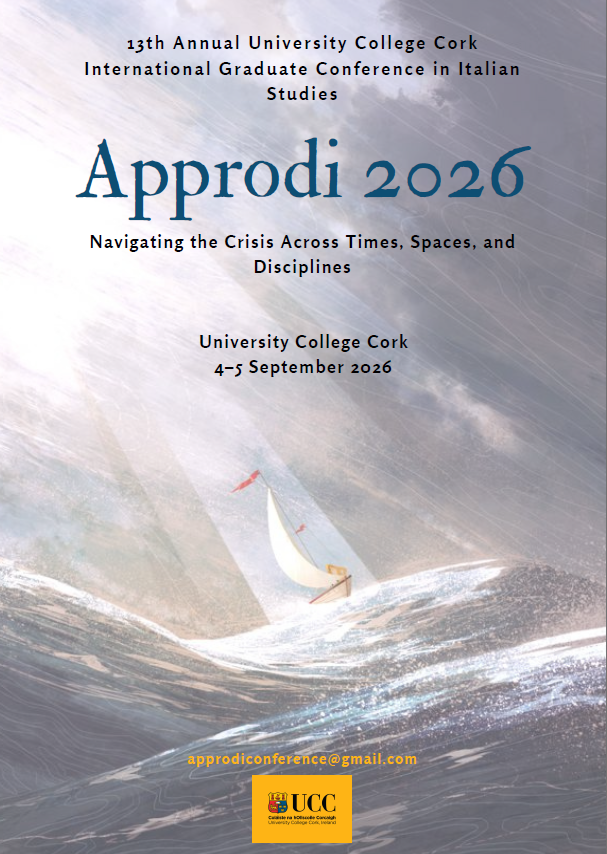
13th Annual University College Cork International Graduate Conference in Italian Studies
APPRODI:
Navigating the Crisis Across Times, Spaces, and Disciplines
On behalf of the PhD students of the Department of Italian at University College Cork, we are pleased to announce the thirteenth edition of the international graduate conference Approdi, to be held on 4-5th September 2026, at University College Cork in Cork, Ireland.
Roundtable speakers: Prof Vittorio Bufacchi (UCC), Dr Chiara Giuliani (UCC), Dr Evelien Geerts (UCC), Prof Declan Jordan (UCC), others (TBA)
Creative Workshop: Yvon Bonenfant (UCC)
CALL FOR PAPERS
In this conference, we invite researchers to engage with the theme of “Crisis” in its broadest sense: crisis as rupture and transition, as a condition of instability that disrupts political, social, cultural, environmental and epistemic certainties, but also as a site of negotiation, adaptation, and transformation. The conference encourages reflections on crisis as both a singular and exceptional moment and a persistent and multifaceted condition that demands new ways of thinking, narrating, and inhabiting the world.
Italian history and culture provide particularly fertile ground for examining how crises are conceived, experienced, represented and contested. From the political fractures of the Risorgimento to the legacies of Fascism, from postwar reconstruction to the anni di piombo, from economic precarity and transformations of labour to ecological disasters, migration, pandemics and the ongoing reconfiguration of identities in the globalised world, Italy has repeatedly been shaped by upheaval and uncertainty. Literary, philosophical, architectural, and social responses (from Dante’s moral and political crisis to contemporary narratives of climate anxiety and displacement) reveal crisis as both a lived experience and a powerful analytical lens for reinterpreting Italy’s past and present and to envision new possibilities for the future.
Drawing on Jean-Francois Lyotard’s reflections on the crisis of grand-narratives (La Condition postmoderne, 1979), Rob Nixon’s notion of slow violence (2011), Reitter and Wellmon’s Permanent Crisis (2021), Antonio Gramsci’s idea of organic crisis and interregnum, Edgar Morin’s concept of polycrisis (1993), and, for the medieval context, Roberta Morosini (2020), who explores Dante, Petrarca, and Boccaccio’s Mediterranean as a dynamic space of cultural circulation and negotiation – just to name a few – we approach crisis not only as a historical or political event, but also as an affective and embodied condition unfolding across different temporalities and scales.
Within this horizon, we recognize that we ourselves are often implicated in multiple and intersecting forms of crisis. Academic precarity, practices of cultural translation, digital overload and questions of ethical responsibility situate us inside the very dynamics we seek to analyse. Institutional transformations, funding instability and the pressure of globalised knowledge reproduction further shape our professional and personal lives. Our position is therefore not external or neutral. Instead, it is embedded within the same processes of instability and negotiation that this conference aims to interrogate.
Taking into account the diverse manifestations and interpretations of crisis, the conference aims to foster dialogue on how individuals, communities, narratives, and cultural practices confront, negotiate, contest and reimagine moments of instability. It also invites reflection on the concept of crisis itself, its uses, limits and its potential to open new ways of rethinking the present.
Possible topics include (but are by no means limited to):
● Migration, borders, and humanitarian crises
● Environmental catastrophe, climate anxiety, and sustainability
● Crisis and the body (illness, disability and trauma)
● Gender, sexuality, and crisis of norms or identities
● Colonial, postcolonial, and decolonial perspectives
● Crisis narratives in literature, film, media, architecture, and the arts
● Memory, temporality, and historical rupture
● Language, translation, and communicative breakdown
● Academic precarity and the university system crisis
● Situated knowledge and intellectual responsibility within crisis
● Digital, technological, and epistemic crisis
● Political, institutional, and democratic crises
● Economic precarity, labour, and class struggle
In an effort to foster an interdisciplinary and transhistorical dialogue, we invite proposals from postgraduate researchers working across a wide range of fields and methodologies (such as Literary and Cultural Studies, History, Philosophy, Political Science, Sociology, Anthropology, Gender and Sexual Studies, Migration Studies, Environmental Studies, Visual and Performing Arts, Translational Studies, Media Studies, Digital Humanities, Architecture, and related disciplines) provided that contributors engage with Italian contexts, histories, cultures, or imaginaries.
Beyond traditional academic papers, we also welcome artistic and creative contributions, such as performances, visual or sound works and other experimental formats. The format and delivery of these contributions will be tailored to the specific needs required.
PROPOSALS: Proposals need to include a title, a 200-300 word abstract and a short bio (max. 100 words) with name, affiliation, contact information (phone number and e-mail address). Please add any information on any needed technical equipment. Proposal should be sent as Microsoft Word or PDF attachments to approdiconference@gmail.com
Please format the subject line as follows: “[Last name] – Approdi 2026”.
PRESENTATIONS: Presentations should not exceed 20 minutes and may be in Italian or in English.
FORMAT: The conference will be held in person only.
SUBMISSION DEADLINE: July 15, 2026
For inquiries or further information please contact approdiconference@gmail.com.
Organizing committee:
Giulia Bernuzzi, Ylenia Costantino, Elisa Rosati, Chiara Valcelli